Video Remote Interpreting Explored
  • What is Video Remote Interpreting
  • VRI Vs. Live Interpreters
  • TerpTube
  • At Ryerson!
  • Benefits of feedback in ASL over English!
  • References

Video Remote Interpreters  Vs. Live Interpreters 

There are both pros and cons to using video remote interpreters. Here are some of the benefits and drawbacks of using a video remote interpreter:
Benefits of Live Interpreters
Picture
Drawbacks
Benefits of Video Remote Interpreters
  • One hot topic of debate is whether or not Video Relay Interpreting is an appropriate method of interpretation in hospitals.  One of the main benefits of VRI however is that it can be used to connect hospitals in remote areas to larger hospitals in the area.  -The example here comes from Maine:

"
Using high-speed Internet access, a deaf patient at a hospital in a place like Dover-Foxcroft can link up with a specially trained interpreter in the greater Portland area. The interpreter can help physicians and nurses on the scene understand the patient's problems and pains." 
(Editorial, 2001)  
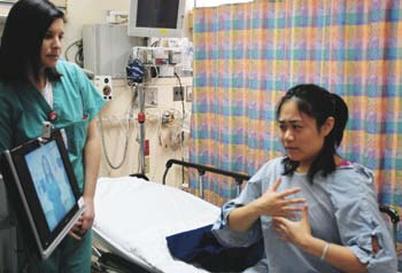
  •           This specially trained medical interpreter would probably have an advantage in a medical setting over a randomly selected emergency interpreter who just happened to live the closest and be on call. (Ibid)

  • Another benefit to VRI is the instant communication aspect.   The article sourced above focused on the egregious wait times for life saving procedures  Deaf people face while awaiting an emergency interpreter in a rural area.  Video Relay interpreting eliminates these wait times. 
Picture

     Drawbacks
  • One disadvantage to Video Relay interpreters is the tremendous variation of regional signs. (Sullivan, 2006)  interpreters in one area of the country may use one sign  that is crucial to the interpretation.  In the ever popular hospital scenario for example  an video relay interpreter who uses this sign:
Could mean pregnant OR stuck depending on where they are located. 


Someone elsewhere may be more accustomed to seeing this sign.  (I.e. Here in Canada) 
Our readings in American Sign Language A Teachers Resource Guide Support this Authors findings. (Baker and Cokely, 1991)  Use of regional signs makes VRI an unreliable method of communication. 
  • Another disadvantage to the use of remote/relay interpreters  interpreters according to Sullivan (2006) is the fact that many interpreters work in one location, leaving very few freelance interpreters to meet the demands in person when preferred 

  • As stated in the Federal VRI video description, this service relies heavily on technology.  If the internet connection is not fast enough, or the camera does not use enough frames per second VRI services will not work efficiently.  In cases such as education or hospitals this can be extremely damaging. 

Conclusion....

It is clear that Video Remote Interpreting does have some viable use; however it is not always the most appropriate choice.  is it really ethical to continually blame a shortage of interpreters for the usage of VRI in undesirable settings (such as a hospital where a live interpreter would undoubtedly be more appropriate)?  Or can something be done about the shortage?   


This is a great segue into my next page........ 

Powered by Create your own unique website with customizable templates.